
Public being
A different, simpler approach to public speaking.
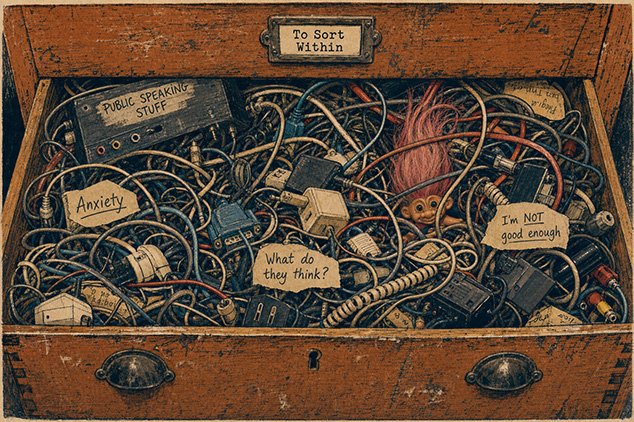
Public speaking is a bit like that old tech drawer full of leads. We don’t mean to make it complicated, but it is. It’s too tangled and difficult to sort out.
We don’t like being the centre of attention. We’re told to stand in a particular way. We’re often harsh on ourselves. We feel judged. We think the audience is bored, and we don’t want to feel anxious.
Like the troll below, we often have a harsh voice inside us as we try to speak. And we’re self-monitoring, so our brain bandwidth is being used up before we’ve even started speaking about the actual subject.
What a mess!
How can we possibly do public speaking if all of that is tangled up and needs sorting?
We need to untangle it. We need to Simplify. Demystify. And Rethink how we approach public speaking.
And that’s what is often missing.
Public Being
Part of the simplification is learning to be in public.
We don’t start by learning how to perform, because that usually means putting even more pressure on ourselves. We start by learning how to be in public.
We start with some really fundamental, basic things.
In front of people, can I allow myself:
to be looked at, and to look?
to breathe?
to slow down?
to pause?
to think?
to take my place?
to be present in the moment?
simply to be?
No need to be impressive, no need to perform.
That's how you get your brain back. And then you can speak.
These things sound simple. But if you are anxious your nervous system may treat them as anything but simple.
Can I get my brain back when people look at me?
Can I pause without feeling that something has gone wrong?
Can I take up space without feeling that I need to justify myself?
Learning public being takes some new skills. So this is where we start the course.
Demystify, Dethreat
We also need to understand what our wonky brain does when it senses social threat. We demystify anxiety and understand what happens when your brain senses social threat. Then we “dethreat” the things that have come to feel threatening.
Our anxious brain can overthink social risk. It can become incredibly self-focused and make confident guesses about what other people are thinking:
They're judging me.
They've noticed I'm shaking.
They're bored.
That pause was terrible.
Everyone is looking at me.
The problem is that our brains can treat these guesses as facts.
So we learn to develop a more accurate picture of what public speaking is actually like, rather than seeing everything through the lens of an anxious brain.
I call this dethreat. I see it as a useful branch of demystifying. I made the word up because I needed one to describe what I was teaching.
We learn to dethreat things such as being the centre of attention, audiences, judgement, blank faces and pauses.
We're not pretending that nothing uncomfortable will ever happen. We're learning in small steps that many of the things our anxious brain treats as threats don't need to be treated as threats.
Public being makes public speaking simpler
You don't start by learning how to perform. Performance can often mean putting pressure on yourself to be better, more confident or more impressive than you normally are.
You start by learning to be yourself while people are looking at you. Once you've done the work of dethreating, you get out of your own way. Your attention can move to the person, the connection and the topic.
Public speaking starts to feel more like a chat.
You don't start by learning how to speak. You start by learning how to be.
Public Being isn't simply another technique added to the drawer. It's part of simplifying the drawer.
And it doesn't necessarily stop with public speaking…
“I have taken my first solo trip abroad, spoken at an internal public event, organised two summer socials for my team, been able to hit various goals at work, dined alone at various restaurants and had conversations with strangers which has led me to learn a different language.
Most importantly I am comfortable with being seen, which has affected my confidence and life in so many different ways. I am sure this is just the start.”
Netty
How participants talk about learning public being
taking space and learning to pause
“Guidance on 'public being', allowing myself to take up space and not feeling like I have to be perfect was just what I needed... I found the work around pausing really useful as standing in front of an audience and not filling the silence is really hard for me.”
Emily
taking the steps
"I think you hit the nail on the head when speaking about 'public being'. That is exactly what I need to be more comfortable with to achieve what I wanted from the course. The course made me realise there are steps to achieving more confidence and the way they were broken down was really achievable and encouraging."
Rachel
removing the pressure to perform
“I loved how public being was a precursor to public speaking, which meant removing any pressures to be interesting. Giving myself the freedom of silence and space was a revelation.” Eva
presence and taking space
“I am starting to allow myself to take space (I let everyone else be free, with no judgement, so why not me!) and just to be more present. I never thought this was possible.”
Abbie
simple way
“Something profound happened to me in your course which I think was your message about 'public being' rather than public speaking, alongside your modelling of vulnerability and connectedness - simply sharing yourself with your audience. I did feel slightly nervous on both occasions, but then relaxed and stayed with myself throughout the sessions - I even enjoyed it! It's been a revelation and has stayed with me in a simple but very experiential and immediate way”
Emma
the barrier getting smaller
“It’s a course on being comfortable with public being... tackling the foundational issues so that public speaking itself is much easier... I feel so much more confident and that nothing is holding me back.”
Jess
changing a life long fear
“I have a lifelong fear (extreme discomfort) of being seen, of being the centre of attention, and of speaking up and out in front of a group of people. I could see how this had placed serious limitations on my life. This course looked as though it would address this issue - but in a gentle and nurturing, rather than a scary and threatening way.
It helped us to understand our anxiety, to accept it and to be ok with it.
Get alongside with compassion, rather than face head on. To think in terms of ‘public being’ rather than a performance. I liked the way the course was structured, how it gently unfolded over the 2 days. Introducing us to the foundation knowledge about anxiety and confidence, before gently encouraging us, step-by-step to practice the eye contact and blank faces, before speaking. Then moving on to standing up in front of the group, before speaking. Doing the small steps/actions to start building confidence.”
Sue
taking things back to basics isn't feasible in normal life…
"The course started out from the most basic stage of being comfortable with Public Being, which so many other courses completely overlook. It didn't take much to make a huge difference, but taking things back to basics isn't feasible in normal life and your course did this in a safe, positive environment which broke so many barriers for me. By the end of the two days, I was looking forward to talking in public and really can't wait to stand in front of an audience. I never thought I'd think that."
Jody
Why public being?
Three names get used on this page, so here's what each one is doing:
Taking Your Place in the World is the course. It names where you're heading.
Public being is where you start. Being in public before speaking in public.
Relational Presence is a practice I trained in and still teach. Public being is how we get there.
Public being comes from a very simple question: can I just be in public?
I've spent years in presence work alongside other facilitators, and I owe it a great deal. Relational Presence in particular: the quality of attention between two people, the willingness to be seen and to look.
But something kept coming up in my courses. Some people find it really hard to be the centre of attention. They look at a room of blank faces and see judgement. Before they can do any of it, something has to happen with that.
Relational Presence is a good place to arrive. For some people it isn't a place to start.
So I needed something that came first. It was part of my teaching long before it had a name. It grew out of the work and out of the reading, mostly Acceptance and Commitment Therapy, where I found the idea I needed most: the problematic feelings don't have to go first. We can take really small steps towards being with them.
Then it needed a name. I started with the idea that this isn't just about public speaking, which is why the course is called Taking Your Place in the World. I still love that name. But it describes the end goal: the confidence to be in the world for whatever you need it for, public speaking included. It doesn't describe where you start.
There's nothing flashy about the phrase I found. That's the point. Public speaking needs to be simpler. Public being is about as simple as it gets. But getting there takes lots of little steps.
It's a small name for a powerful way of rethinking where we start with public speaking.
Public being in practice
If you want to explore public being for yourself, have a look at the courses in Bristol, London and Manchester. Or have a free ten-minute chat with me first.