
Why We Fear Public Speaking: 14 Ways Your Brain Works Against You and What To Do About It.
After 26 years of running public speaking courses through Speaking Infront, and working with close to 9,000 people, I've noticed that the fear of presenting and public speaking rarely comes from one source. It comes from a cluster of habits, beliefs, and brain processes that seem to work against us very effectively. Here are the fourteen, (yes fourteen!) I see in every course followed by 10 pointers to help you rethink. Plus the ultimate shift you need to make…
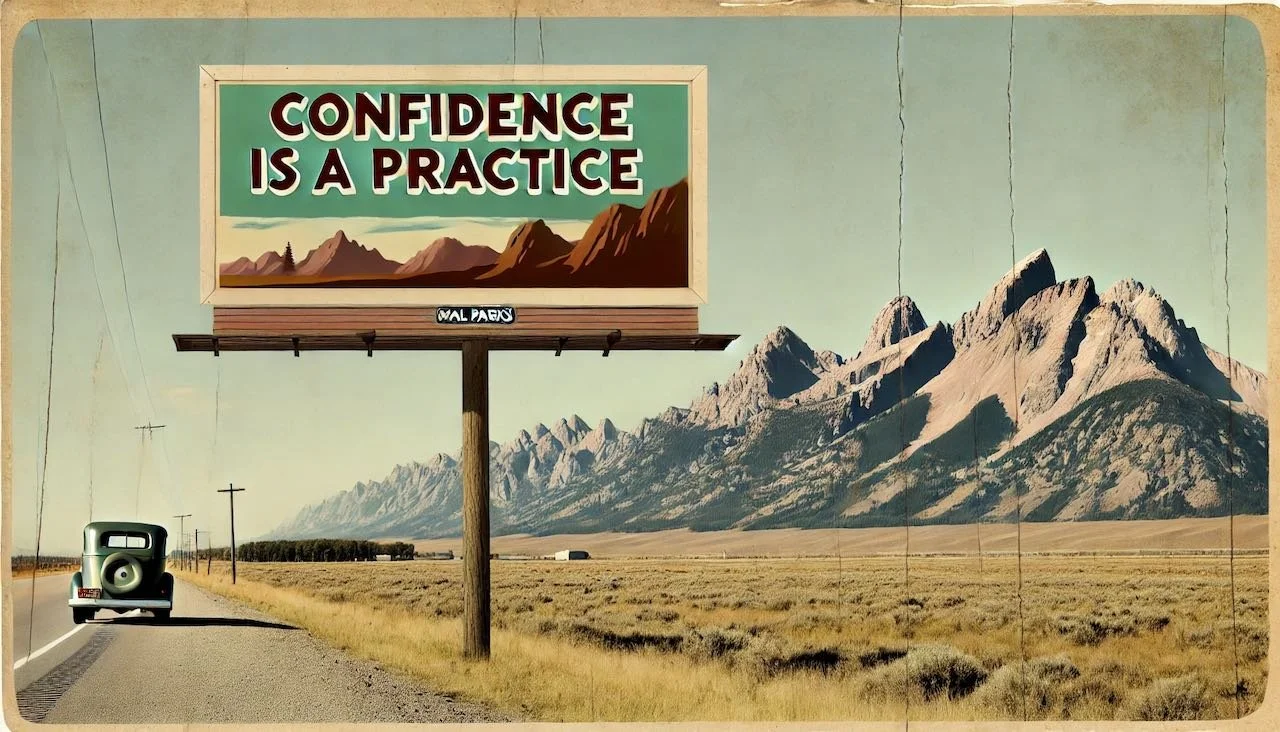
Confidence doesn’t just turn up, you need to practice it first!
1. Excessive expectations
"I have to be perfect. I have to be funny. I have to remember every single word." The more pressure we pile on ourselves, the less mental bandwidth we have for the actual presentation. Around 60% of the people who come to my courses are perfectionists, and perfectionism is a reliable route to the kind of anxiety that shuts us down for fear of not matching up to some perfect ideal.
2. Harsh self-judgement
Would you speak to a friend the way you speak to yourself before a presentation? Probably not. Most of us run a quiet critical commentary: "You're not good enough. What do you know? Who are you to take all their attention?" Up to 70% of people experience impostor syndrome at some point.[1] Public speaking tends to turn up the volume on that inner critic.
3. Focus on fear
Our brains are well-evolved for worrying about the past and anticipating the future, and not very good at staying in the present. As a presentation approaches, we tend to run a kind of internal cinema, replaying past failures and rehearsing future disasters on a loop. Fear becomes the main event, rather than the thing we're trying to say or the connections we are trying to make.
4. The threat from being the centre of attention
For the vast majority of people who come to my courses, having all eyes on them registers as a threat. Being looked at makes you feel vulnerable. This is ancient biology, not weakness, but it is something that needs addressing directly and reframing.
5. Mistaking how we feel for how we look
A very common fear among anxious speakers is the strong belief that their inner chaos is visible to everyone in the room. It rarely is, but the conviction that it is can be overwhelming. Even world-famous speakers like Oprah Winfrey and Brené Brown report feeling sick or nervous but they come across cool as the proverbial cucumber. Even Barack Obama goes to the gym before big speeches. Working in groups you see how often that inner turmoil is not visible to the audience.
6. Waiting for confidence to arrive
Many people are holding out for a day when confidence will simply turn up on its own. It won't. Confidence is not a feeling that precedes action. It follows it.
7. Misreading audience faces
Audiences are passive listeners. They don't nod, smile, or respond the way people do in conversation, and for an anxious speaker, those blank faces can look hostile. In fact, they are almost always neutral. When you're sitting in an audience yourself, you're probably quietly concentrating on what the speaker is saying, or you might also be thinking about what's for dinner or making connections to your own experience. Typically, you are not judging the speaker. People listening to you will be doing the same.
8. Treating anxiety as the enemy
We often tell ourselves: other people don't feel like this, so there must be something wrong with me. But anxiety around public exposure has been part of human biology for millions of years. The problem is rarely the anxiety itself. It's the struggle not to have it. If we go into battle against difficult feelings, we tend to give them oxygen and they get bigger. When you battle yourself, it's a battle you can't win.
9. Treating speaking as a performance
If presenting feels like performing, then the bar becomes "I have to be better than I normally am." That framing just piles on the pressure. The more we can move towards thinking of a presentation as a conversation, the more we can bring our actual selves into the room, and the more people will connect with who we are and what we are saying.
10. Avoidance
Avoiding uncomfortable feelings provides short-term relief. But as clinical psychologist Harriet Lerner says: “Avoidance will make you feel less vulnerable in the short run but it will never make you less afraid.” Over time, avoiding difficult feelings just makes them grow. By taking small steps towards discomfort people find their comfort zone expanding. This is a big part of my own practice where I often encourage myself to go towards something difficult and usually end up feeling stronger.
11. The wrong advice
"Just practise more" is the most common public speaking advice, and for anxious speakers it is often the least useful. If you are scared of presenting, practising more can simply mean getting better at being scared. Practice matters, but what and how you practise matters more.
12. It's all about me
Anxiety is self-focused by design. It narrows our attention inward, convinces us that everyone in the room is watching and judging us, and makes the whole experience about how what people think of us, rather than what we are trying to say. The more it becomes about us, the more anxious we tend to become.
13. Fear of making mistakes
Most of us carry a belief that mistakes will be remembered, that they will damage our reputation, that people will think less of us. So we tell ourselves: I cannot make a mistake. The pressure this creates is counterproductive. In practice, how a speaker handles a mistake often builds more trust than a flawless performance would have. Ella Fitzgerald won a Grammy for her version of ‘Mac the Knife’ — she forgot the words halfway through and improvised around the fact that she had forgotten them. She didn’t seek to cover up a ‘mistake’, she leaned into being human and was justly rewarded by her peers and the music industry.
14. An overloaded brain
If you've read through the thirteen points above, the fourteenth will come as no surprise. When our brain is simultaneously monitoring our performance, judging our delivery, worrying about how we are being perceived, running disaster scenarios, and trying not to make mistakes, it has very little left for the actual topic. This is why our minds go blank.
So, what can we do to get our brains to work with us?
The full answers take two days on my course to work through properly, but here is the direction of travel. Simplify, understand your feelings better and make it less about yourself.
See public speaking more like a chat.
Not a performance, not a polished delivery, just you talking to some people about something you know about. When we think "presentation" we start thinking we need to be a shinier version of ourselves. We don't. Everyday language works better than formal language almost every time. And the odd um? Fine. Honestly. Leave it there. It actually helps the audience breathe.
Move your focus onto helping people rather than yourself.
Think about what you're trying to do for your audience. Think about your project, your team, the people you're there to help. When you're focused on a purpose bigger than yourself, something shifts. You're thinking less about you. And when you're thinking less about you, you'll probably find you're less anxious too. Not as a technique, just as a natural consequence of where your attention is. (And notice that choosing where you put your attention makes a huge difference.)
You don't have to know everything.
Many of us put ourselves under huge pressure to have all the answers. We tell ourselves we have to know everything about our topic before we can stand up and talk about it. A lighter position is to see yourself as curious, as still learning. "This is my take on the subject, and I can always learn more." That's honest, and it takes the weight off. It's the position I take myself, after 26 years of teaching. The people who struggle most on my courses are often the ones who feel they have to know all the answers. The ones who relax into "I'm still learning" tend to do better.
Get used to blank faces.
Audiences don't look like the people you chat to. In a normal conversation people nod, smile, react. Audiences mostly just sit there looking neutral. If you're anxious, your brain will read that as boredom or hostility. It almost certainly isn't. Next time you're sitting in an audience yourself, notice what's actually going through your head. It's probably the weekend, what's in your fridge, or your own connection to what's being said. You're almost certainly not thinking critically about the speaker. Your audience isn't either. Next time you're in an audience, take a look around. Get used to blank face land.
Re-think mistakes.
Trying not to make mistakes takes up huge bandwidth, and it doesn't even work. If you handle a mistake well, your audience will actually trust you MORE, not less. Probably the opposite of what you'd expect. Focus on recovering well, not on being flawless.
Be willing to feel anxious.
By this point you've already got a lot working in your favour. You're thinking chat not performance, you understand blank faces, you're focused on your audience rather than yourself. The threat has come down. So now we can talk about the anxiety that's still there. Stop trying to get rid of it. The more you fight it, the bigger it gets. Just let it be there. Not enjoying it, not welcoming it, just stopping the fight. It's not easy, but it's far better than the bigger struggle of trying not to have it. Tip: practise this in smaller moments first. Chat to your neighbour, talk to someone on the train. Baby steps. Learn to feel a little uncomfortable and let it be there.
Practise being the centre of attention.
When other people are the centre of attention, how nasty are you? Probably not nasty at all. People are not staring at you, they are just looking at you. Being the centre of attention often comes with an adrenaline surge, but that's normal. You know how much time you spend thinking about yourself? Quite a lot, I'm betting. Guess what: other people are mostly thinking about themselves, NOT you.
Confidence comes with practice, but not in the way you might think.
You don't feel confident first and then act. It's the other way round. Actions come first, feelings follow. Start a conversation with a stranger. Speak up at a meeting. Do the uncomfortable thing, and confidence grows from there. I still practise this myself, after 26 years of teaching. Confidence is about trusting yourself more, even when you're feeling uncomfortable. And trusting yourself more means being kinder to yourself. Encourage yourself rather than being harsh and self-critical.
Your inner critic is not telling you the truth.
The inner voice evolved to keep us safe by keeping us small or making us be perfect. It's a brain process that's NOT bothered about your happiness or your career progress.
It's worried about social threat.
That's its focus. The inner voice is just a thought. It's not the truth. Being kinder to ourselves doesn't mean giving up, it means encouraging yourself like you would a friend. It means being kinder to yourself when you are being willing to feel uncomfortable and that’s not weakness, that’s strength.
The really fundamental shift you have to make, in the words of course participant Helene: “My main takeaway is that to be at ease at public speaking, you need to be at ease at being you.”
Building that trust in yourself is what confidence practice is all about.
I wish you well.
John
If you want to talk about any of these issues contact me john@speaking-infront.co.uk,
[1] Sakulku & Alexander, 2011